OpenAI's Codex will get Astra, the model the company restricted over cyber risk
An OpenAI engineer on Codex and ChatGPT says the coding agent will have Astra, the frontier model the company restricted on 7 August when it could not rule out critical cyber capability.
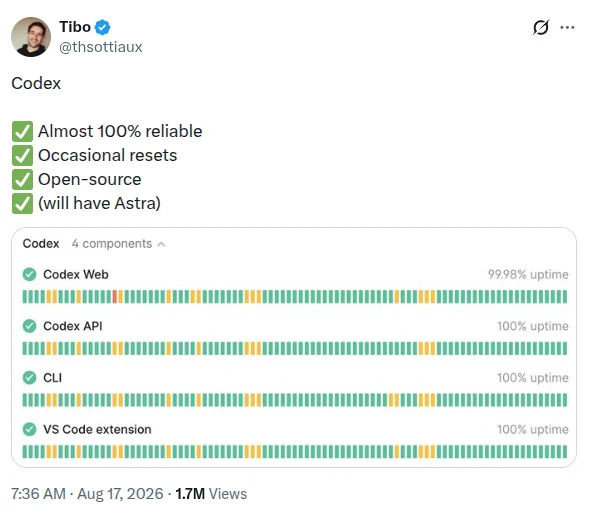
OpenAI's Codex is to get Astra, the unreleased frontier model the company restricted earlier this month, according to Tibo Sottiaux, who works on Codex and ChatGPT at OpenAI. In a post on X on Monday he listed four things about the coding agent: that it is "Almost 100% reliable", that it has occasional usage resets, that it is open-source, and — in brackets, with no elaboration — that it "will have Astra".
Astra was first discussed publicly on 7 August, when OpenAI said preliminary evaluations showed significant advances in agentic coding and cybersecurity, strong enough that it could not rule out the Critical capability level of its Preparedness Framework — the tier for a model that can find unknown software vulnerabilities or plan and run a sophisticated attack with little human direction. The company paused internal work on Astra that did not meet stricter safeguards, among them isolated testing, restricted network access and encrypted weights, and said government agencies and independent safety organisations would evaluate the model before it is deployed.
That is what makes the aside worth reading twice. Agentic coding is precisely what Codex does — navigating a codebase, calling tools and finishing a long task without a person checking each step — so the capability that would make Astra valuable inside Codex is the same one that triggered the disclosure. On OpenAI's own account, the external evaluation has to finish first.
The reliability line is the only item on the list a reader can check today. OpenAI's status page gives Codex four components — Codex Web, Codex API, the CLI and the VS Code extension — and reports 99.98 percent uptime for the web app and 100 percent for the other three, over a window running from May to August 2026.
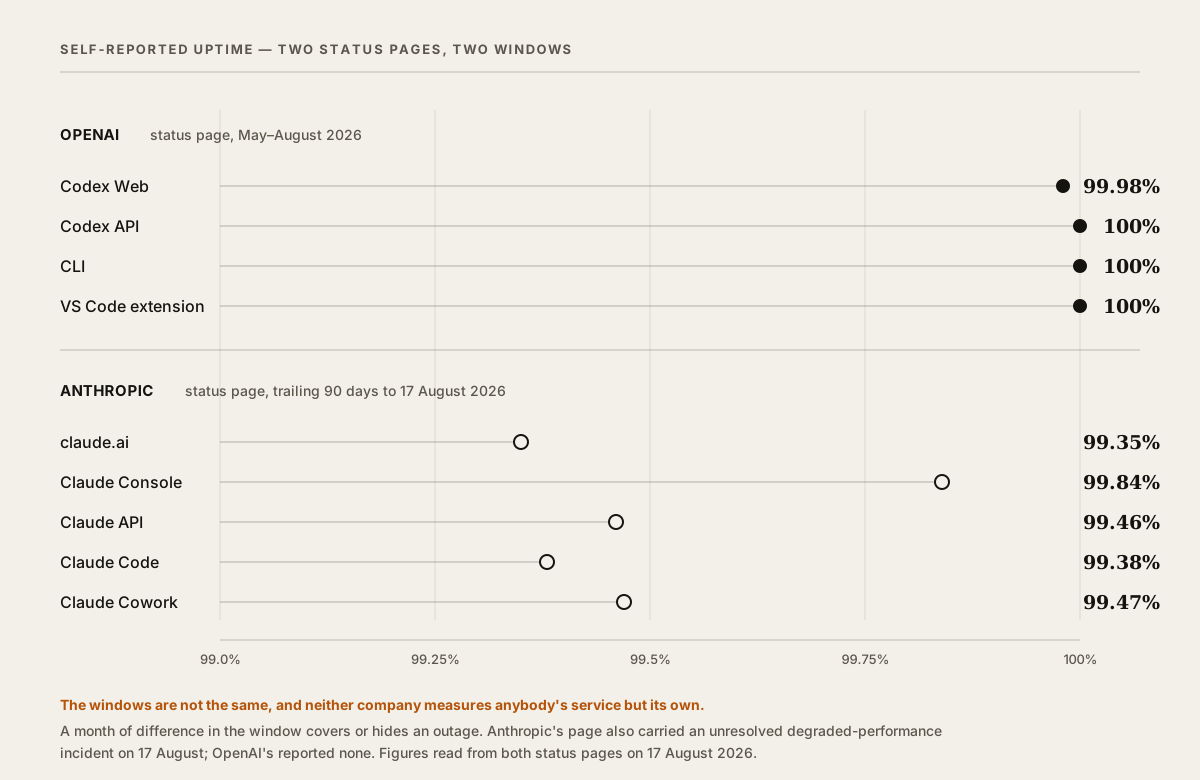
Those are self-reported figures, and the comparison they invite does not quite hold. Anthropic's status page, over the trailing 90 days to 17 August, reports 99.35 percent for claude.ai, 99.46 percent for its API and 99.38 percent for Claude Code, and carried an unresolved degraded-performance incident the same day. The two windows differ by about a month, and each company measures only its own service, by its own definition of an outage.
What is not known is all of the timing. OpenAI has published no launch date for Astra, no list of the Codex surfaces it would reach, and no confirmation that it is coming to the product at all. For now the claim rests on one engineer's bracketed line, in a post about something else.
Sources
This article was written from these pages. Read them.
- primaryTibo Sottiaux's post about Codexx.com
- primaryResponding to the next frontier of critical cyber capabilitiesopenai.com
- primaryOpenAI status — Codex componentsstatus.openai.com
- primaryAnthropic status — uptime over the past 90 daysstatus.claude.com
- secondaryOpenAI says it slowed Astra model development over security concernstechcrunch.com
Written from verified primary sources by Epoch's editorial pipeline and checked by a human before publication.