Nvidia will backstop the rent on the data centre that buys its chips
The company is putting $1.5bn into the landlord and credit support behind OpenAI's 20-year lease at an Ohio campus that could return it $150–200bn per hardware generation. Jensen Huang answered the obvious question in his own announcement, before anyone asked it.
Nvidia said on Monday that it will secure the land, power and shell for an eight-gigawatt data centre campus in Portsmouth, Ohio, invest $1.5bn in the company building it, and provide credit support behind the lease payments of the tenant. The tenant is OpenAI. The compute inside will be Nvidia's, exclusively, for twenty years.
The company published two things at once: a press release with the numbers, and a long essay from Jensen Huang under the title *Securing the Infrastructure of Intelligence*. The essay is the more interesting document, because roughly a third of it is Huang answering questions nobody had yet put to him in public.
One of those questions is the heading *Is this circular financing?* His answer is two words and a sentence: "No. OpenAI will pay the lease."
What was actually announced
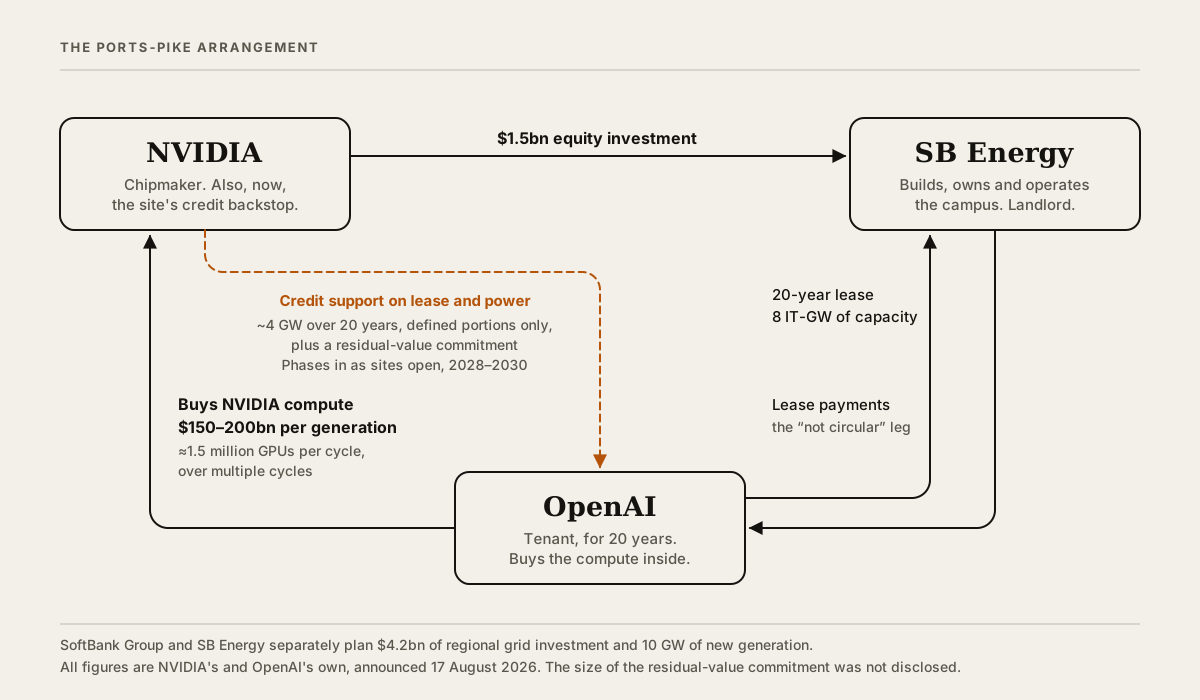
SB Energy — the SoftBank-backed developer — will build, own and operate the PORTS-Pike Technology Campus. OpenAI takes a twenty-year lease on eight IT-gigawatts of capacity. Nvidia invests $1.5bn in SB Energy, and separately provides what the press release calls credit support on land, power and shell for the initial 4.25 IT-GW, with an option over the remaining 3.75.
One detail in the press release is easy to skim past and hard to unsee. Nvidia's $1.5bn buys it a stake in SB Energy "joining existing investors SoftBank Group and OpenAI". The tenant already owns a piece of its landlord. As of Monday, so does the company selling the tenant its chips.
SoftBank and SB Energy say they will put $4.2bn into regional grid infrastructure and build 10 GW of new generation. There is an $80m community benefits fund, and OpenAI is adding $40m on top. Capacity comes online in phases from 2028.
Then the numbers that explain why Nvidia is in the room at all. Huang writes that each generation of Nvidia systems deployed at the site "could represent approximately 1.5 million NVIDIA GPUs, or approximately $150 billion to $200 billion in NVIDIA revenue" — and that the site can support multiple upgrade cycles over twenty years. Across OpenAI's total commitments, he puts the opportunity at "roughly $600 billion of NVIDIA compute through 2030".
The question he answered first
It is worth being precise about what the "no" covers, because Huang is careful and the care is informative.
Nvidia is not paying the rent. OpenAI is the tenant and OpenAI pays the lease. What Nvidia has done is stand behind that obligation — "defined portions of lease and power payments, along with a specified residual-value commitment", effective in phases as the data centres are placed in service between 2028 and 2030, declining as OpenAI pays.
So the structure is not a loop of cash. It is something narrower and, depending on your view, more or less comfortable: Nvidia is underwriting the creditworthiness of a customer whose purchases of Nvidia hardware it books as revenue. If OpenAI pays, the arrangement costs Nvidia nothing beyond the equity cheque. If OpenAI cannot, Nvidia is on the hook for a defined slice of a twenty-year property obligation on a site built to hold its own chips.
Huang gives the reason plainly, and it is the most candid paragraph in the essay: frontier labs "may have strong customer demand and rapidly growing revenue yet still lack the decades-long infrastructure contracts and investment-grade financing capacity needed to secure the AI factory infrastructure independently." Their growth, he writes, is "constrained not by algorithms or customer demand, but by the availability of compute."
That is a vendor saying its largest customers cannot finance the thing they need in order to keep buying from it — and that the vendor will bridge the gap.
What is not disclosed
The size of the residual-value commitment. That is the number that would let anyone outside Nvidia put a figure on the downside, and neither document contains it.
"Defined portions" of lease and power payments is likewise undefined. So is the trigger: what counts as OpenAI failing to pay, and what Nvidia owes at that moment. The essay says exposure "declines" as capacity comes online and OpenAI pays, which tells you the shape of the curve and nothing about its height.
None of that is unusual for an announcement. It is worth writing down anyway, because the case for calling this ordinary supply-chain discipline and the case for calling it vendor financing both turn on numbers that were not published.
The reported figure was double
Epoch's radar caught this story before the announcement. The Information reported on 15 August that Nvidia was in talks to invest $3bn in SB Energy; Techmeme picked it up the same evening, and the trade press followed the next day. The announcement two days later says $1.5bn.
Either the deal came in at half the reported size, or the $3bn figure covered something the final structure splits differently. Worth holding onto the next time a number appears in a pre-announcement report about this deal.
The argument on the other side
Huang's defence of the structure does not rest on the balance sheet. It rests on CUDA.
"NVIDIA compute is versatile, fungible and broadly adopted," he writes. If OpenAI walks away, the capacity can be resold "to another qualified tenant across NVIDIA's global ecosystem". The chain is explicit: "CUDA makes NVIDIA compute versatile. Versatility makes it fungible. Fungibility drives utilization and durability — making NVIDIA compute a productive asset: rentable and financeable."
This is not nothing. A twenty-year lease on a site that can only ever host one customer's workload is a very different risk from a lease on a site whose contents have a deep secondary market, and Nvidia's installed base is the deepest in the industry. The argument is that Nvidia is not underwriting OpenAI so much as underwriting demand for accelerated computing, which it has better information about than any lender does.
The counter is that this reasoning has been tested in a rising market and not in a falling one. The resale case assumes a queue of qualified tenants at the moment a frontier lab stops paying — which is also the moment that queue is most likely to be short.
Why land, power and shell, and why now
The acronym in the essay is LPS, and Huang's framing of it is the part of this announcement most likely to matter beyond one site. His argument is that chips stopped being the binding constraint and real estate started: advanced packaging, memory and networking were the shortages Nvidia learned to secure years ago, and land with power attached is the shortage now.
Hence the claim that the company is "applying that same discipline" to LPS as it did to semiconductors. Read charitably, that is a supply chain company extending its supply chain. Read sceptically, it is a chipmaker discovering that its customers' constraint has moved somewhere its cheque book can reach.
Both readings predict the same next twelve months: more of these. Huang says the approach will be "strategic and disciplined", limited to "exceptional sites", and that most customers will keep securing their own LPS. He also says Nvidia may extend PORTS-Pike beyond the initial 4.25 GW to take the remaining 3.75.
What to watch
The phasing dates, 2028 to 2030, are when the guarantee becomes real rather than announced. Until then this is a commitment with no cash flow attached, and the disclosure that matters is whatever Nvidia files about it — a residual-value commitment of this size and duration is the kind of thing that shows up in a 10-K long before it shows up in a blog post.
Watch also whether the second tranche gets taken. Nvidia securing 4.25 GW is a large customer helping a supplier. Nvidia securing all eight, at one site, with one tenant, is a different company than the one that sold graphics cards.
And watch the language. Huang did not have to publish a question headed *Is this circular financing?* The fact that he did is the clearest signal in either document about what Nvidia expected this week to be about.
Sources
This article was written from these pages. Read them.
- primaryNVIDIA Guarantees SB Energy's PORTS-Pike Technology Campus in Ohionvidianews.nvidia.com
- primarySecuring the Infrastructure of Intelligence — Jensen Huangblogs.nvidia.com
- primaryOpenAI joins PORTS-Pike projectopenai.com
- secondaryNvidia in Talks to Invest $3 Billion in SB Energy (15 August)theinformation.com
- primaryJensen Huang's post announcing the arrangementx.com
Analysis written and edited by a person at Epoch, from the primary announcement and the published benchmark figures. Charts are the subject's own; the reading of them is ours.